Blog Details

The path towards Efficient District Heating & Cooling in Europe

Adobe Stock/Robert Poorten

District heating and cooling (DHC) offers a series of advantages when compared to individual solutions – resilience, flexibility, and safety, to name a few. But, increasingly, DHC is also helping cities and regions to decarbonise and reach their sustainability goals. How can this technology be a key element in Europe’s aim to achieve net-zero emissions by 2050?

Europe is no stranger to district heating and cooling. More than 19.000 networks are spread across the continent. In Northern and Eastern Europe, DHC provides heating and cooling to a considerable percentage of the population. Countries like Denmark, Estonia, and the Czech Republic have large shares of their heat demand met by DHC. A key challenge arises, however. In many cases, these networks are becoming increasingly inefficient. High supply temperatures, an ageing network, and the use of fossil fuels jeopardise their environmental appeal and hinder their attractiveness to new customers.

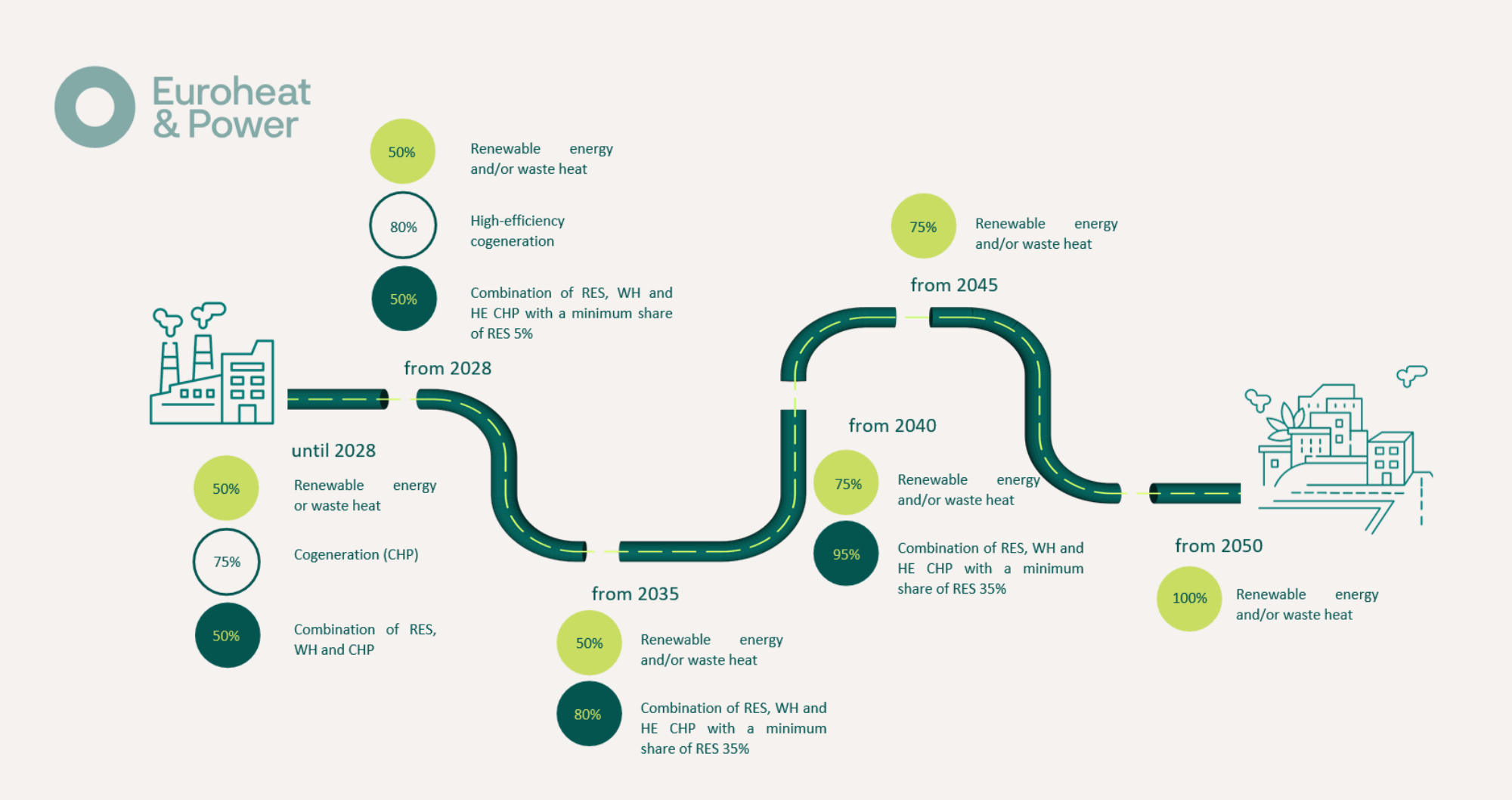
To reverse this trend, the EU set a clear path for the complete decarbonisation of DHC networks on the continent in the recast of the Energy Efficiency Directive (EED). In the 2023 document, the bloc lays out the timeline and a clear definition of what it considers to be efficient DHC. Currently, networks with at least 50% of the energy generated through renewable sources or waste heat, or 75% through cogeneration heat and power (CHP), or 50% of a mix of these sources may be classified as efficient. The criteria will tighten gradually, starting in 2028, until it reaches 100% use of renewable energies by 2050.


Efficient DHC path until complete decarbonisation. Source: Euroheat & Power

Member States can alternatively choose the sustainability performance criteria based on greenhouse gas emissions. By the end of 2025, those DHC networks emitting up to 200 grams of CO2 per kWh will be considered efficient. From 2026, the emissions should be no more than 150g/kWh. Like the first set of criteria, 2050 is the deadline for full decarbonisation. However, to use this criterion, States should have communicated their preference for this mechanism to the Commission by February 2024.

The Energy Efficiency Directive (EED) update is a welcome change. Heating and cooling account for almost half of all energy consumed across the continent. The emphasis on this sector in the document, along with the importance of district heating for decarbonisation, highlights its strategic role in reducing carbon emissions. Moreover, it acknowledges that many alternative sources of heating and cooling, particularly sustainable and locally produced options, remain largely untapped. Utilising these sources will not only help ensure affordability but also protect the sector from external disruptions.

According to Pauline Lucas, policy director at Euroheat & Power, the EED recast is beneficial for many reasons. Besides its clearer definition, “it offers DHC operators the flexibility to either gradually increase the share of renewables and waste heat or follow a defined CO₂ reduction trajectory. Moreover, the directive mandates that no additional fossil fuels are used in systems built or substantially refurbished after 2030, reinforcing the sector’s commitment to a sustainable, fossil-free future“. The flexible and gradual elements will ensure that different district heating and cooling networks have enough room to reach carbon neutrality while adapting their current realities to the requirements present in the legislation.

Investments are also key to the uptake of efficient district heating and cooling. Refurbishing the networks, adapting them for sustainable, low-temperature energy sources, and installing smart meters and digital technologies will demand significant amounts of money. To Gabriele Pesce, innovation and sustainable finance director at Euroheat & Power, public funding alone will not be enough, and private investments will be key to this transformation. “Private capital helps bridge this gap, enabling faster deployment of innovative technologies, improving energy efficiency, and enhancing the overall sustainability of DHC systems“.

Pesce emphasises that investor confidence depends on a stable policy environment: “We need a stable regulatory framework, clear long-term policy signals, de-risking mechanisms such as guarantees or blended finance, and greater visibility of bankable projects.”
 

Source: Shutterstock/EURACTIV

These challenges are being addressed by ENABLE DHC. The project is helping the European Union with its decarbonisation efforts. The investment plans developed in each case study will lay the foundation for the modernisation and increased efficiency of the networks. One key element of the project is the close cooperation with local authorities and utility operators. This synergy between public and private initiatives will allow the creation of horizontal and all-encompassing plans, with a focus on the adoption of renewable energy sources and waste heat integration.

Grid modernisation is another key element being taken into consideration when discussing the investment plans with the partners inside and outside the project’s consortium. The deployment of new technologies will allow a reduction in the supply temperature and a decrease in energy demand.

In total, 9 cities in 7 different European countries will serve as case studies for the project’s ambitious plans. The lessons learned in the demonstration sites will later be replicated by follower cases, who will benefit from knowledge sharing schemes on how to develop robust investments to transform local heating and cooling network in efficient systems according

Related Posts

Leave a Comment

Your email address will not be published. Required fields are marked *